
"Angola coffee history"
200 article(s) found

A brief introduction to the description of flavor and aroma characteristics of boutique coffee beans in West Java, Indonesia
Java Coffee-Culture Java coffee beans are famous for their early Java coffee, which refers to Arabica coffee formerly produced on the island of Java. It has a strong aroma, low acidity, taste lubrication, combined with mocha coffee, the Java mocha mixed coffee has been popular and has become synonymous with top coffee. At that time, it was sold to Europe.

A brief introduction to the cultivation of boutique coffee beans in West Java, Indonesia, geographical location, climate and altitude
At present, 90% of the coffee beans exported from Indonesia are Robusta beans, and only 10% are Arabica. Before 1920, due to a major environmental disaster, Indonesian coffee varieties were replaced with Robusta beans, so Mandarin coffee in Sumatra is a rare Arabica bean, a treasure before it was discovered in the Blue Mountains. The output of such authentic products is also very small.

A brief introduction to the market price of boutique coffee beans with low acidity in West Java, Indonesia
Java coffee growing environment and main producing area Robusta belongs to lowland cultivation, which is resistant to high temperature, drought, rain, insect pests and strong adaptability. it can grow very well on flat land, and the harvest does not necessarily need manual work, but can be carried out completely by vibration machine. There are two kinds of Robusta coffee that we often come into contact with: A.P.Robusta and W.I.B.Robu.

Description of Coffee Bean Flavor introduction to Manor by Grinding Calibration method of thick and thin varieties in producing area
Description of coffee bean flavor production area thick and fine varieties grinding scale treatment manor introduction Masakron: material espresso mechanism method: coffee powder 10 g water 50cc sugar-free sparkling beverage (example: Peiluya) appropriate amount of lemon juice 10cc general coffee preparation method: coffee powder 30 g water 120cc sugar-free sparkling beverage (example: Peiluya) appropriate amount of lemon juice 10cc production method of coffee

A brief introduction to the flavor, taste and aroma characteristics of boutique coffee beans in West Java, Indonesia.
Java produces only a small amount of Arabica beans, most of which were imported from Africa after the rust disaster. This kind of coffee has a strong bitter taste after roasting, but the aroma is extremely light. Although it has low acidity and delicate taste, it is rarely used for direct drinking. It is often used to mix mixed coffee, or to make instant coffee. Java coffee is produced in Java, Indonesia, and belongs to Elaraby.

A brief introduction to the treatment method of grinding degree and baking degree of Indonesian West Java boutique coffee beans with strong flavor
At present, 90% of the coffee beans exported from Indonesia are Robusta beans, and only 10% are Arabica. Before 1920, due to a major environmental disaster, Indonesian coffee varieties were replaced with Robusta beans, so Mandarin coffee in Sumatra is a rare Arabica bean, a treasure before it was discovered in the Blue Mountains. The output of such authentic products is also very small.

A Brief Introduction to the Grinding Degree and Roast Degree Treatment Method of Indonesian West Java Fine Coffee Beans with Nutty Flavor
Indonesian coffee is generally not crowned with Indonesian names, but directly with island names, such as Java and Sumatra, which were later brought to Jamaica by the British. By 1925, coffee cultivation had become a tradition in Central and South America. That same year, coffee was grown in Hawaii, the only coffee producer in the United States, and Hawaiian coffee is one of the best in the world. mesh

A brief introduction to the cultivation of boutique coffee beans in West Java, Indonesia with low acidity, geographical location, climate and altitude.
Among the Asian coffee-producing countries, Indonesia is a very noteworthy one. Indonesia is an island country in the Indian Ocean, the islands are distributed on both sides of the equatorial line, of which three islands: Java, Sumatra and Sulawesi produce the world's important coffee. In the mid-17th century, the Dutch brought coffee trees to Ceylon (Sri Lanka) and Java, Indonesia. India in the 18th century

Catimorkatimo Coffee History Katim English Catimor Coffee Features
Professional coffee knowledge exchange more coffee bean information please follow the coffee workshop (Wechat official account cafe_style) 1, coffee transmission route outline Ethiopia to Yemen (595850), Yemen to India and Java (1600), Java to the Netherlands (1706), the Netherlands to Paris (1714), Paris to Bourbon (1718) Martinique Island, Haiti (1723)

A brief introduction to the treatment method of grinding degree and baking degree of Indonesian West Java boutique coffee beans with taste lubrication
At that time, Java coffee sold to Europe was a very special kind of coffee. At that time, it was shipped to Europe and the United States by sailboat, and the distance was long and the speed was slow, so it took a lot of time to transport. In this case, the coffee seems to have undergone a special fermentation and has a very unique taste. Later, when the ship replaced the sailboat, people drank because the transportation time was shortened.

Arabica coffee beans, what is the knowledge of coffee cold all over the world?
Professional coffee knowledge exchange for more information about coffee beans, please follow the coffee workshop (Wechat official account cafe_style) one. Costa Rican coffee has full grains, ideal acidity and unique strong aroma. Tarrazu of Costa Rica is one of the major coffee producing areas in the world. The volcanic soil in Costa Rica is very fat.

What kind of coffee is grown in Laos? How to improve the cultivation of coffee in Laos?
Although many of us associate unexploded ordnance (the remaining bombs and shells caused by the conflict did not detonate) with the long-over war, this is a reality for the Lao people. Laos is a landlocked country in Southeast Asia, bordering Vietnam, China, Cambodia, Thailand and Myanmar. Per capita is the country with the most bombs in history. As a result, almost half of the suitable farmland

Which coffee beans are Arabica beans? what kinds of Arabica coffee are there and which ones taste better?
Professional coffee knowledge exchange more information about coffee beans please follow the coffee workshop (Wechat official account cafe_style) Arabica coffee category one. Costa Rican coffee has full grains, ideal acidity and unique strong aroma. Tarrazu of Costa Rica is one of the major coffee producing areas in the world. Costa Rica

A detailed introduction to the establishment, historical origin and current situation of the International Coffee Organization
The International Coffee Organization is an intergovernmental organization founded in London in 1963. It is composed of coffee importers and exporters. The organization is responsible for implementing the International Coffee Convention and is committed to improving the situation of the world coffee industry through international cooperation. Organizational and functional editorial contributions the International Coffee Organization has made a special contribution to the world coffee industry through: (1) organizing regular high-level meetings

Detailed description of the flavor and taste of the world's top boutique coffee bean varieties
Latin American coffee beans (Central and South America) Brazil: Santos, Bahia, Cerrado, Mogiana Mexico: Coatepec, Huatusco, Orizaba, Maragogype, Tapanchula, Huixtla, Plumako
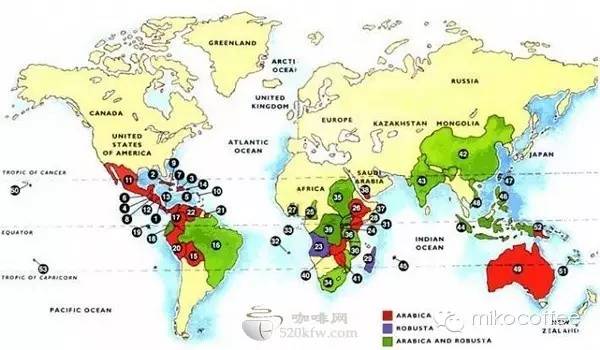
World boutique Coffee beans: the first introduction to Coffee from 53 Coffee producing areas in the World (to be continued)
one. Costa Rican coffee has full grains, ideal acidity and unique strong aroma. Tarrazu of Costa Rica is one of the major coffee producing areas in the world. Costa Rica, with its fertile volcanic soil and good drainage, is the first country in Central America to grow coffee and bananas for commercial value. Coffee and fragrance

How to process coffee
The History of Coffee 2008-01-02 12:40 A legend of coffee was discovered around the 5th century AD on the Ethiopian plateau, a young shepherd accidentally found his sheep eating the red fruit of a bush and became very excited. the young shepherd thought it strange, so he picked a few fruits and tasted it, and immediately became excited. Soon, the shepherd's hair
Have a comprehensive understanding of coffee
Legend of Coffee the person who first discovered coffee: a shepherd in Ethiopia, in the fifth and sixth centuries AD. It is said that Niankadi, a shepherd with talent as a poet, herded sheep on the mountain paths of the Ethiopian plateau every day. He liked to drive the sheep home with a shrill flute, but one day the flute sounded again and there was no sign of the sheep. He looked everywhere. Find sheep